DIAS is Finland’s most popular way to complete housing share transactions
DIAS stands for digital housing transaction and refers to completing housing transactions on the electronic DIAS platform. In a digital housing transaction, the transaction is not completed at a bank branch. Instead, the signatures can be handled from your couch at home, from the dock at your summer cottage, or while traveling, just as securely as in a traditional in-person transaction. A DIAS transaction always includes both a bank and a real estate agent, who are responsible for matters such as the deed of sale and payments.
Completing a DIAS transaction is not difficult. All you need is an internet connection and valid online banking credentials or another method of strong authentication. Ask your real estate agent about the possibility of completing the purchase of a housing share, house, plot, summer cottage, or other property digitally!
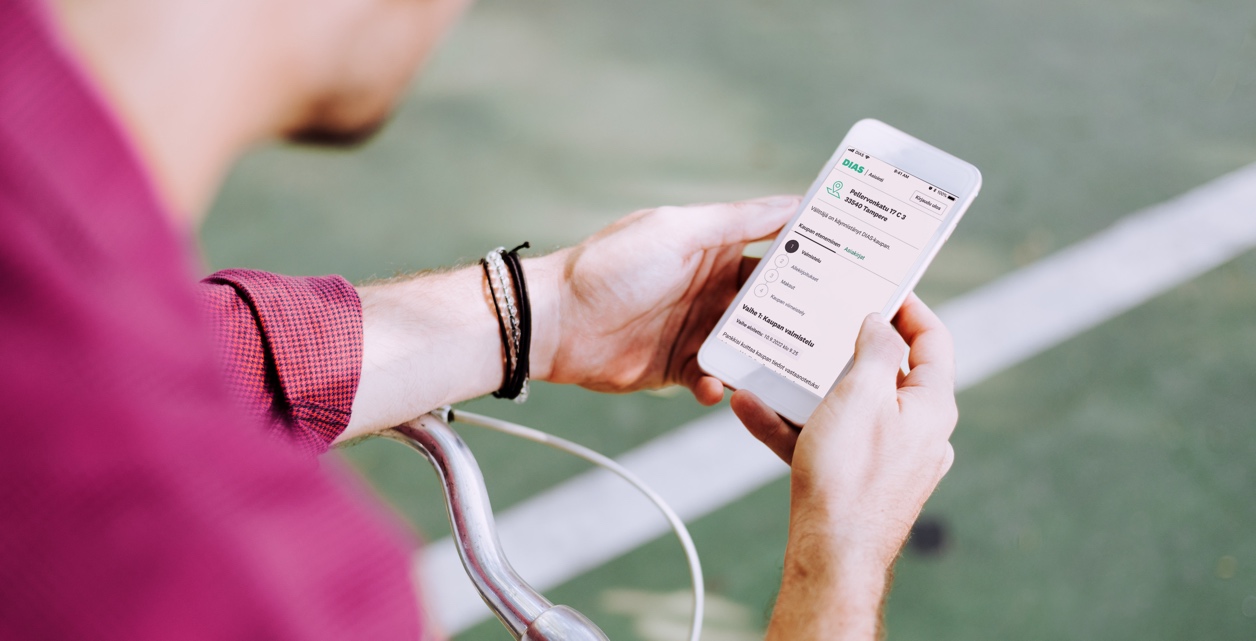
This is how a DIAS transaction progresses
In a digital housing transaction, the signing date is not agreed on in advance. Instead, the transaction can be signed as soon as the real estate agent and the banks have completed their parts of the process. In most cases, a DIAS transaction is ready for signing approximately five banking days after the transaction has been initiated, but many factors can affect the timeline.
You can also follow the progress of your own DIAS transaction in the DIAS online service, where you can read instructions and additional information, sign the deed of sale and authorizations, and download documents. Log in to the service using online banking credentials, a mobile certificate, or the hightrust.id application.
DIAS transaction phases
Before the transaction
The real estate agent prepares the deed of sale and has it approved by the seller and buyer. The seller and buyer agree on matters related to the transaction with their banks.
Initiation of the transaction
The real estate agent sends the transaction information to the DIAS system. You will receive an email from DIAS informing you that the transaction has been initiated.
Preparation by the banks
The banks review and prepare the transaction. This phase usually takes approximately five banking days, but the preparation time for an individual transaction always depends on the customer and the bank.
Signing phase
Next, the real estate agent initiates the signing phase, and the buyer and seller receive invitations to sign by email. In a housing share transaction, the buyer and seller have 24 hours to sign the transaction electronically at e-service.dias.fi.
In a real estate transaction, the signing phase consists of two stages. First, the bank authorizations are signed in DIAS, and finally the deed of sale is signed in the National Land Survey of Finland’s Property Transaction Service.
Finalization of the transaction
The banks handle the payments and registration of ownership. In a housing share transaction, the real estate agent files the transfer tax return and delivers the required documents to the building manager. In a real estate transaction, the buyer files the transfer tax return.
How you can influence the progress of your DIAS transaction
All parties involved in a DIAS transaction – the real estate agent, banks, sellers and buyers – have their own role in the digital housing transaction process. As a seller or buyer, you can influence the progress of your DIAS transaction by ensuring that the following matters are in order:
-
You have agreed on all necessary matters with your bank well before the transaction is initiated
The bank is always involved in a DIAS transaction – even when the buyer is not taking a bank loan or the seller has no loan to repay – and the bank must agree on the transaction details with its customer.
-
Any co-buyers or co-sellers have agreed on the necessary matters with their bank
In a DIAS transaction, all sellers and buyers must manage their own matters with their bank and sign the required bank documents.
-
Debtors or providers of collateral have signed the required documents
If, as a buyer, you receive collateral for your housing loan from another person or persons, those providers of collateral must also sign the required documents with the bank before the DIAS transaction can proceed to the signing phase.
-
Your collateral arrangements are in order if the property being sold is pledged as collateral for a loan at the bank
If you are the seller in a DIAS transaction and the property being sold is pledged as collateral for your own or someone else’s loan, agree on the release of the collateral well before the transaction takes place.
-
The funds required for the transaction are available in your payment account
A DIAS transaction cannot be completed before the down payment, transfer tax or other transaction-related payments agreed with the bank can be paid.
-
You respond when the bank contacts you
Surprisingly many DIAS transactions take longer than expected because the bank cannot reach the seller or buyer. Please answer your phone and check whether the bank has sent you a message in your online bank.
Housing and real estate transactions made easy, flexible and secure
Security
A DIAS transaction is as secure as a transaction completed at a bank branch: it is signed using strong authentication, and DIAS implements advanced electronic signatures in accordance with the eIDAS Regulation. All payments related to DIAS transactions are processed through banks. The DIAS platform has been developed in cooperation with both banks and authorities.
Flexibility
In digital housing transactions, there is no need to find a suitable appointment time at a bank branch or gather all sellers, buyers, the real estate agent and the bank in one place. Transactions can be signed even from the other side of the world.
Ease of use
In a digital housing transaction, the different stages of the transaction, such as signing the deed of sale and making payments to the seller, real estate agent and Tax Administration, are handled as part of the electronic transaction process. This reduces the manual stages of the transaction and the need for physical documents. DIAS also utilizes the National Land Survey of Finland’s electronic interface, which significantly speeds up the registration of ownership rights.
A DIAS transaction is a secure choice
A DIAS housing transaction is even more secure than a traditional housing transaction because it better ensures that information, payments and pledges are transferred to the correct parties. Everything leaves a seamless digital trail, which helps prevent fraud.
Through the DIAS platform, all parties to the transaction can participate seamlessly in the same process. The buyer and seller sign the deed of sale and provide the authorizations required for the digital transaction directly in the DIAS user interface.
An exceptionally broad group of industry participants, such as banks, real estate agents and agency systems, are involved in the development of the platform. The DIAS platform has also been developed in close cooperation with authorities.
Partner banks of DIAS
DIAS partner banks are Aktia, Danske Bank, Nordea, OmaSp, OP, POP Bank, S-Bank, Suomen Hypoteekkiyhdistys, Savings Bank and Ålandsbanken.
Frequently asked questions
DIAS stands for digital housing transaction. It is a housing transaction platform developed in Finland that enables housing share and real estate transactions to be completed flexibly and securely regardless of time or place. In Finland, DIAS is used and developed by nearly all parties involved in housing transactions, from real estate agents to banks.
The first DIAS transaction was completed in June 2019. In 2026, real estate agents already complete well over half of housing share transactions digitally through DIAS.
A digital housing transaction is an easy, fast and secure way to complete a housing transaction anytime and anywhere – while traveling, from your couch at home, and outside banking hours. The buyer, seller, real estate agent and bank do not need to find a common time to meet in the same place.
In a digital housing transaction, the different stages of the transaction, such as signing the deed of sale and making payments to the seller, real estate agent and Tax Administration, are handled as part of the electronic transaction process. This reduces the manual stages of the transaction and the need for physical documents while improving efficiency for banks and authorities, for example.
Digitalization also speeds up the registration of ownership. DIAS utilizes the National Land Survey of Finland’s electronic interface, through which the new owner of a housing share may have their ownership registered in as little as one day instead of several months. This makes it easier, for example, to participate in housing company meetings.
Yes – signatures in a DIAS transaction are made using strong authentication, meaning online banking credentials, a mobile certificate or hightrust.id. DIAS implements advanced electronic signatures in accordance with the eIDAS Regulation.
An exceptionally broad group of industry participants is involved in the development of DIAS, including banks, real estate agents and agency systems. The platform has also been developed in close cooperation with authorities.
As a rule, a DIAS transaction is ready to be signed approximately five banking days after the real estate agent has initiated the transaction. This is the target timeline to which the real estate agents and banks are committed, but many factors affect the actual duration of the transaction. As a buyer or seller, you can help ensure a smooth transaction by making sure you have agreed on the necessary matters with your bank before the transaction is initiated.
A DIAS transaction proceeds as follows:
- Once the terms of the transaction have been agreed upon and the deed of sale is ready, the real estate agent initiates the transaction in the DIAS system. The buyer’s and seller’s banks review the transaction from their own perspectives and prepare the necessary matters together with their customers.
- Next, the real estate agent initiates the signing phase, and the buyer and seller receive invitations to sign by email. In housing share transactions, the buyer and seller have 24 hours to sign the transaction electronically. In real estate transactions, the signing phase consists of two stages, and the deed of sale itself is signed in the National Land Survey of Finland’s Property Transaction Service. Signing always takes place using strong authentication.
- Once the transaction has been signed, the banks handle the payments and the registration of ownership.
DIAS does not charge anything from the seller or buyer. DIAS’ direct customers are agency systems and banks with whom DIAS has agreements.
However, banks and real estate agents may charge the seller or buyer fees related to electronic housing transactions. In these cases, the matter is between the bank or real estate agent and the customer, and DIAS cannot comment on it. We recommend asking about pricing directly from your bank or real estate agent.
A DIAS transaction is initiated by the real estate agent, who sends the information required to complete the transaction – such as the deed of sale – to DIAS through their own agency system. The buyer’s and seller’s banks can see the information they need in DIAS and review the prerequisites for the transaction from their own perspectives. After the reviews, the buyer and seller receive an invitation to sign the deed of sale and provide the necessary authorizations to complete the transaction. After the signatures, the real estate agent and banks handle the remaining matters related to the transaction, such as payments, taxes and the transfer of ownership.
Using DIAS only requires the seller and buyer to have online banking credentials, a mobile certificate or the hightrust.id application. In addition, a prerequisite for a DIAS transaction is that the seller’s and buyer’s banks and the real estate agent are connected to DIAS.
DIAS partner banks include Aktia, Danske Bank, Nordea, OmaSp, OP, POP Bank, S-Bank, Suomen Hypoteekkiyhdistys, Savings Bank and Ålandsbanken. Most Finnish real estate agents also use DIAS. Remember to ask your real estate agent about the possibility of digital transactions!
The DIAS online service, where the deed of sale and authorizations are signed, is available in three languages: Finnish, Swedish and English. You can select your preferred language from the language menu in the upper right corner of the online service before signing in.
The emails sent by DIAS regarding your transaction, as well as the DIAS support portal offering instructions and tips for DIAS transactions, are also available in all three languages.
Please note, however, that the real estate agent is always responsible for the deed of sale in a DIAS transaction and for the language of the deed of sale. The deed of sale will therefore be available on the DIAS platform in the language in which the real estate agent created it.
A digital housing transaction involves the seller, buyer, real estate agent and the seller’s and buyer’s banks. All parties can see the information included in the deed of sale. In addition to the deed of sale information, each bank only receives the information required to manage its own part of the transaction.
The bank reviews the contents of the deed of sale and checks the prerequisites for the transaction from the perspective of the pledge holder or financing provider. Before a digital housing transaction, matters related to loans must be agreed with the bank in the same way as for transactions completed at a bank branch.
Unfortunately, at the moment a DIAS transaction cannot be completed without a real estate agent. A DIAS transaction always requires a real estate agent who initiates the transaction through their own agency system.
Most likely you can, as nearly all housing and real estate transactions can be completed digitally. In addition, DIAS can be used for cottage and plot transactions. However, the transaction must always involve a real estate agent who initiates the DIAS transaction through their own agency system. So remember to ask your real estate agent about the possibility of completing the transaction digitally!
Most likely you can, but make sure with the real estate agent selling the apartment. A real estate agent is required to initiate a DIAS transaction, so remember to ask the real estate agent about the possibility of a digital transaction.
Unfortunately not. At the moment, DIAS can be used for transactions involving previously owned apartments that have either a paper share certificate or an electronic registration of ownership in the National Land Survey of Finland’s Residential and Commercial Property Information System. DIAS transactions are also not possible for RS properties.
The seller and buyer may have different banks. However, a DIAS transaction is not possible if there are multiple sellers and the sellers have different banks. Similarly, if there are multiple buyers, the buyers must share the same bank in order for a DIAS transaction to be possible.
Yes – a limited liability company can be the seller or buyer in a DIAS transaction.
A DIAS housing share transaction is possible when the seller is an undivided estate. If the estate is the buyer, the transaction cannot be completed through DIAS.
In real estate transactions, an estate cannot currently be a party to the transaction.
Yes – a DIAS transaction can also be completed when the buyer is not taking a loan or when the property being purchased will not remain as collateral for the bank. The buyer’s bank remains involved throughout the entire process even if no loan is taken.
On the DIAS platform, the deed of sale is in digital form. However, you can easily print or download the deed of sale in whichever format you prefer – electronic or paper.
DIAS is a Finnish company founded in 2018. Its owners are Alma Media, OP Financial Group, S-Bank, Aktia and Danske Bank. In Finland, DIAS employs around twenty housing transaction professionals in customer service, software development and business development roles. In addition, an exceptionally broad group of industry participants, such as banks, real estate professionals and authorities, are involved in developing the DIAS platform.